SANDRINE DESIGN STUDIO

ARTISANS CONNECTION
Clay-Ways

Janeth, owner of Clay-Ways
There is something quietly magnetic about the work of Bay Area ceramic artist Janeth. The kind of presence that doesn’t ask for attention, yet inevitably holds it—much like the pieces she creates.
Janeth’s path to ceramics wasn’t exactly linear, though it feels, in hindsight, entirely inevitable.
Like many artists, she explored a range of creative outlets early on—painting, drawing, photography, even design—before encountering clay in a ceramics and sculpture class. That was the turning point. While other mediums offered expression, clay offered something closer to a relationship. It stuck, quite literally and figuratively.
« Working with clay can be a roller coaster of feelings from joy to frustration »
What began as curiosity quickly turned into something deeper. There is, she admits, a certain emotional volatility to working with clay—moments of quiet triumph followed by the occasional (and humbling) defeat. It is, as she describes it, a bit of a roller coaster. Clay has a mind of its own, and it is not above reminding you of that. But for Janeth, the reward lies in the final moment: a finished piece, resolved and tactile, holding the memory of every decision made along the way.
« The fact that someone is going to use that object in their daily life, makes the whole process of making them worthwhile »
Nearly a decade later, that initial spark hasn’t dulled. If anything, it has refined itself. Over the past five years, Janeth has focused her practice on functional ceramics—objects meant not only to be admired, but to be lived with. There is a particular kind of satisfaction, she notes, in knowing that something made by hand becomes part of someone’s daily ritual. A cup for morning coffee, a bowl that anchors a table. These are not just objects; they are quiet companions.

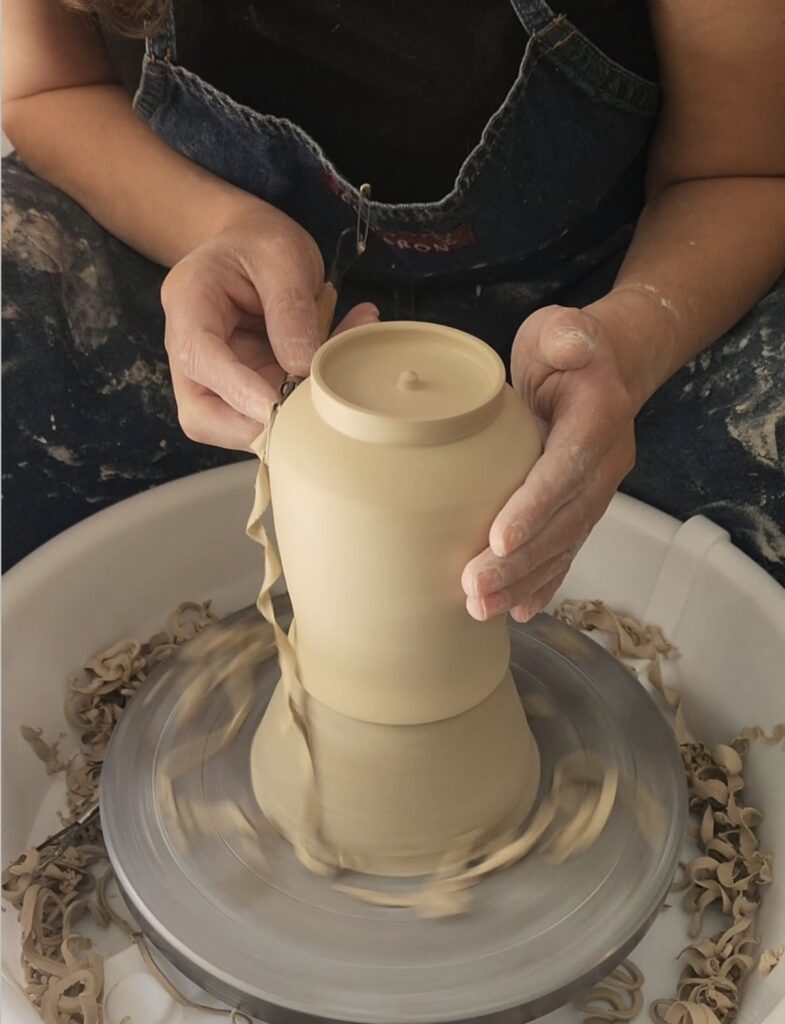

Her inspiration moves fluidly between past and present. Museums remain a favorite source—particularly ancient artifacts whose forms have endured centuries. One imagines her walking through galleries, mentally sketching silhouettes and proportions, already translating them into something new. But her references are not confined to history. Books, contemporary artists, conversations with friends, and yes, even the occasional scroll through Instagram all find their way into her creative vocabulary.
Nature, however, is where her work becomes most distinctly her own. The ocean, the desert, volcanic terrain—these landscapes inform not only the palette but the very essence of her pieces. Her current collections echo these environments in abstract ways, suggesting rather than describing. A glaze might pool like deep water; a textured surface might hint at cooled lava. There is a sense of place, but never anything too literal. It is this restraint that gives her work its quiet sophistication.


If the shaping of a piece is an act of discipline, decoration is where Janeth allows herself a bit more freedom—and perhaps a bit more fun. It is her favorite part of the process, and understandably so. This is when ideas come quickly, sometimes all at once: which glaze, which technique, which combination of materials will bring the piece to life. It is also, she admits, the moment of highest stakes. In ceramics, the difference between success and failure can hinge on a single decision made at this stage. No pressure.
And yet, that tension seems to be part of the appeal. Working with glazes, slips, oxides, and engobes, Janeth navigates a delicate balance between control and surrender. The kiln, after all, always has the final word.
“this stage of the process, is when the piece comes to life, and there are many materials I can use, such as glazes, underglazes, slips, oxides, engobes and more. This step is an important moment, as the success or failure of the piece depends on this.”
The result is a body of work that feels both grounded and quietly expressive—pieces that carry the imprint of their maker without ever feeling overstated. In a world increasingly drawn to the immediate and the disposable, Janeth’s ceramics offer something slower, more intentional. Objects to be used, yes—but also to be noticed, if only for a moment, in the rhythm of everyday life.
